Pages

Saturday, November 10, 2012

Halloween

We were in Arequipa on October 31st so we got to see Halloween happening there.  Most of the action we saw was in the Plaza de Armas, Arequipa's main square (below).


There were lots of cute kids in cute costumes...


                                                                                   Some most interested in chasing pigeons.


And others were busy running around with their friends.


While we were eating dinner in a small restaurant not far from the plaza, we saw lots of kids coming in for candy from the restaurant.  We never did hear anything like "trick or treat."  When we inquired later about that phrase the person seemed bemused by the question - we gathered that is not part of the process here (didn't see any signs of "tricks" either).  After dinner we went back to the plaza which had become even more crowded.  There were, however, many fewer young ones out (and those still there looking more tired if not already asleep) but they'd been largely replaced by an older adolescent crowd.


There was also a smaller but vocal and present anti-Halloween crowd parading around Plaza de Armas on both the 30th and the 31st, chanting "Christo si, Halloween NO!"


Thursday, November 8, 2012

Lake Titicaca - 2/2

We stayed with a family on the island of Amantani, a relatively near-shore island with about 800 families (4k people), broken into 8 communities.  These 8 communities rotate overnight tourist responsibilities, with each taking on about 8 weeks of tourists a year.  Of our community's 102 families, 25 participate in the tourist opportunity, in which they house and feed and have responsibility for up to 4 tourists for an 18 hour period (lunch through the next day's breakfast) for 30 soles (about $12) per person, paid directly to the family. Our family was delightful, rendered especially so through the exceptional linguistic abilities of a third person in our group, a cardiologist from Slovenia, who generously translated and shared with us. 

The family keeps sheep and chickens (quiet chickens!), right next to the house.  A donkey lives next door.

The chickens had access to a shelter that adjoins the house.  Nicely worn broom.  Wooden chopping block.

The view from their house.  There was a small outhouse back here, too, with a non-flushing toilet (no seat, standard in this part of the world).  Families taking part in tourism are required to have an outhouse for tourist use; our family's was dedicated to guest use only, but they had a family one, too.
Our lunch included three of the 3K varieties of Peruvian potatoes: round white potatoes, cucumber and tomato slices, fried cheese, two varieties of fingerlike potatoes.  Good food.
Our room, bright and cheery in the daylight. Four times the size of the dining room.  Clearly tourist fare. One light in the room, solar-powered.
Emiliana, the 34-year old mom, in her kitchen, cooking breakfast.
The rest of the family, dad Roberto in back, then Nelson (10), Elizabeth (12), Kelly (9).  They leave the island once a year to go to Puno to get necessities.
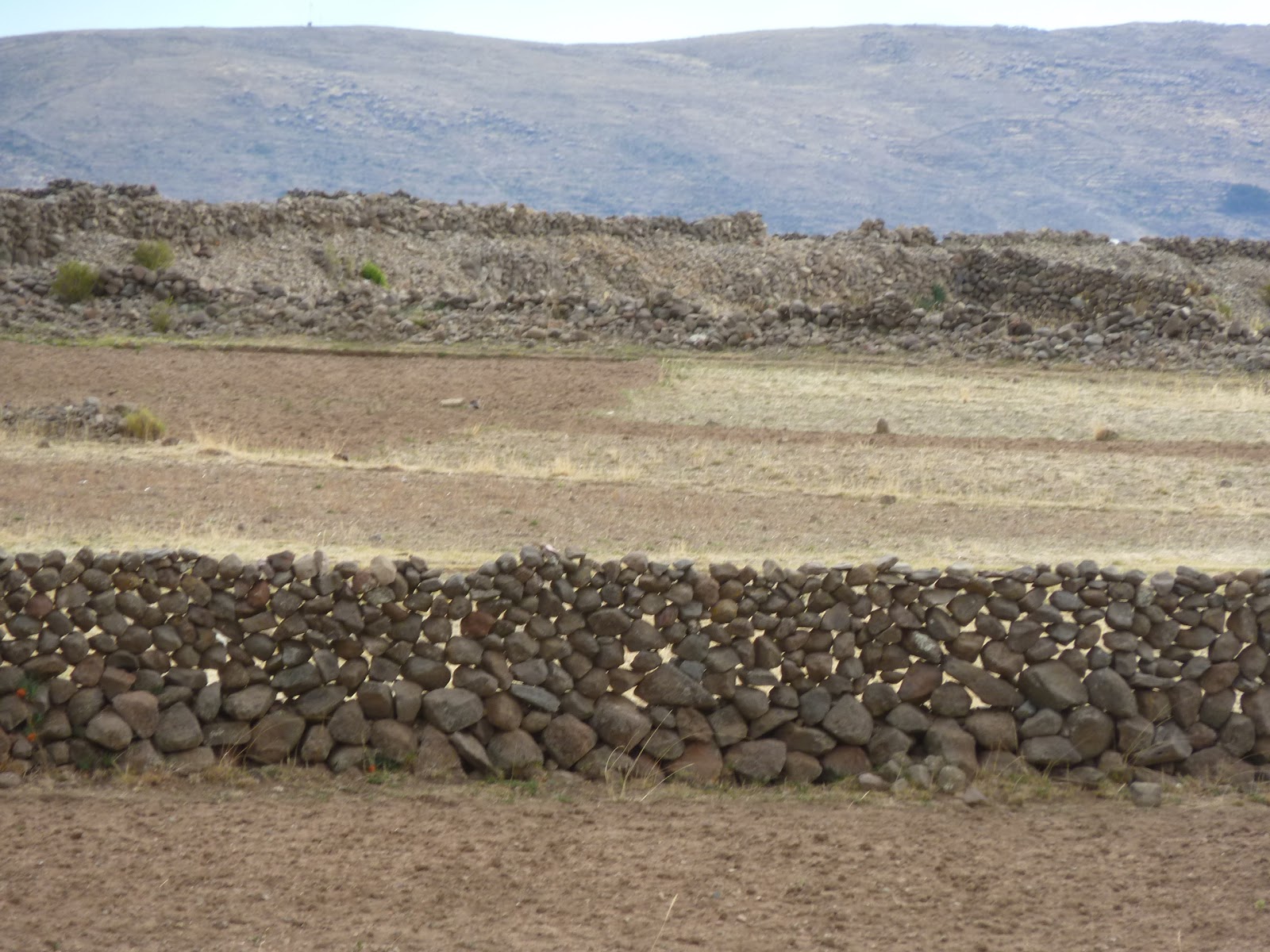
The lacy stone fence on a walk up to the top of the island.
The knitting style on this island included tension provided by yarn around the neck.

A lovely hummingbird attracting flower, called the cantota.  Locals knit yarn versions of these flowers, for good luck. 
Looking over agricultural terraces to Taquile island, the next day's stop.
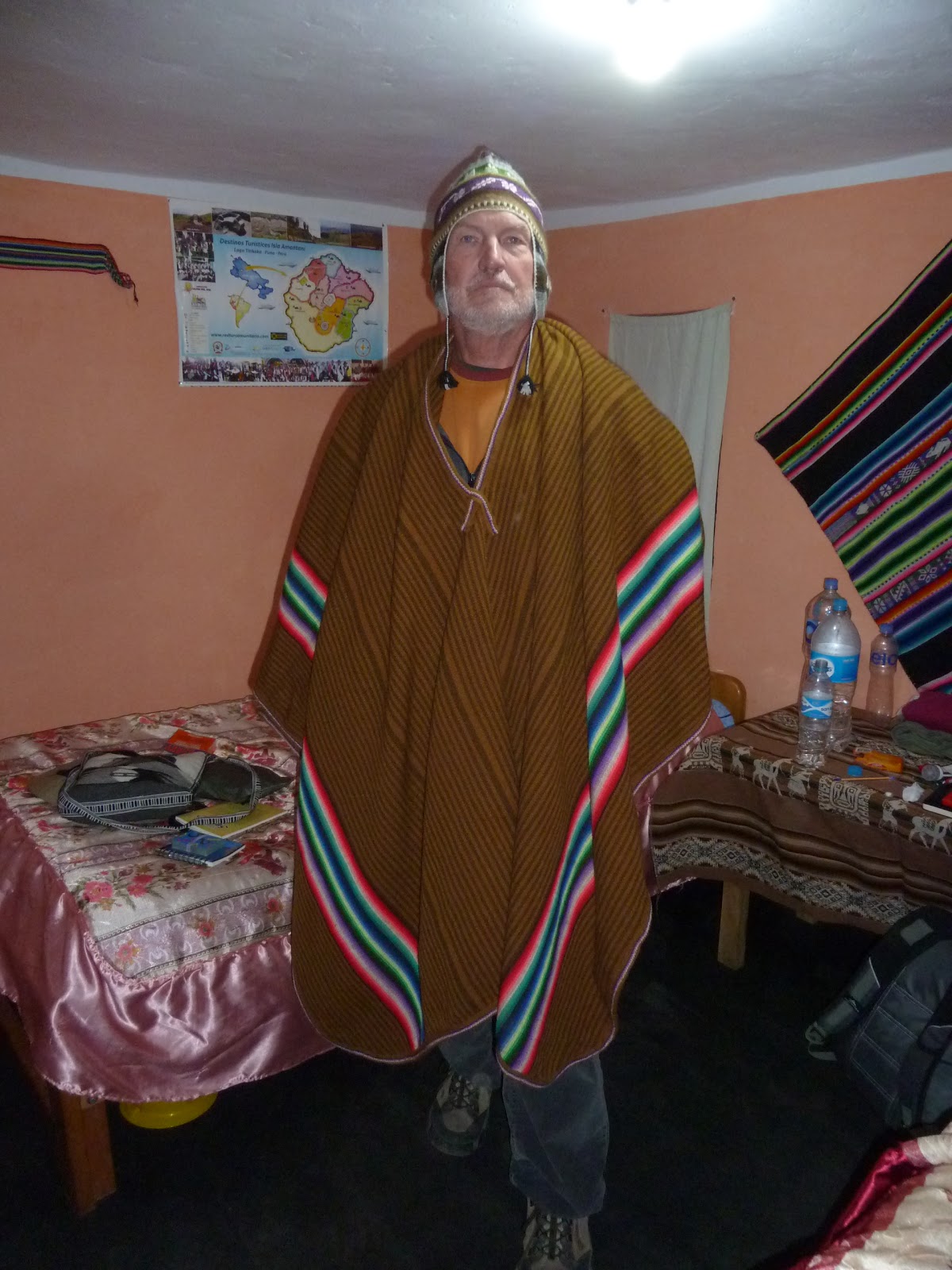
After dinner we were outfitted for a community dance.  Steve in hat and poncho, me in a wool skirt, fancy shirt, cummerbund, and a fancy embroidered shawl that is the island's traditional ladies' hat (all communities have an identifying hat).  Somehow the ladies could keep this shawl on their heads, when they walked, jogged, even when they danced - another special talent I don't have.  The dancing was mostly stomping and moving in a circle.  
 

Steve dancing with Roberto and Emiliana (notice the scarf still resting perfectly on her head while she energetically dances).
The next morning we got on our boat and went to the island of Taquile, a fascinating place that houses 15 cows, one donkey, and 2,000 humans, no motorized transportation.  We saw no one in other than traditional dress here (except tourists).  We heard lots about their culture, which is very unusual, including the arrival of children prior to (and required for) marriage, the men knit special things including their hats and the women weave; their clothing indicates their married status, and much more. 


Village elders (black hats). Anything other than the white shirt, black vest and pants, fancy belt mark and hat mark one as a tourist here.

Unmarried ladies wear big pompons.

Married men wear red hats and wear the side purse, a gift from their wives, in which they traditionally carry coca leaves.

A plow being carried from one terrace to another, by a married man (red hat).


Unmarried lady (big pompons), with baby.

We left the island, by descending 535 steps, and passed a family of folks working their field.  

After navigating the big, big lake, a small channel through the totora reeds leads back to Puno.

Wednesday, November 7, 2012

Lake Titicaca - 1/2.

We're back from Titicaca, and to very pleasing election results. Yay for America in so many ways!

The 300km bus ride from Arequipa to Puno (Peruvian town on the shores of Lake Titicaca) is 6 hours of beautiful arid high desert, with lots of alpacas, vicunas, and sheep, and a few people and a few little towns.  Photos from the bus window, sorry.  


The little white spots are a mix of sheep and alpacas.
The lake is 3810m, the highest navigable (by commercial boats) lake in the world.  BTW, Beavis and Butthead have done a lasting disservice to Lake Titicaca; our guide was quick to point out that the pronunciation involves a guttural rendition of "caca", (kkkhakkkha) not the soft way we always say it, which, as everyone knows means "poo" in Spanish.  The lake's name actually translates to gray puma (a sacred cat).  Locals who know some English are a little defensive about this. 

The very clay-colored town of Puno, on the shores of Lake Titicaca.
Our first night on the lake we stayed on the Yavari, a steamship that was commissioned by the Peruvian government in the 1860s.  Made in Great Britain, it and a sister ship were manufactured there into 2267 pieces, shipped in crates across the waters (Atlantic to Cape Horn up the Pacific), then put on a train in Peru, then transported by mules across the Andes, a trip that took 6 years to get all the pieces to Puno.  They were finally assembled at the lake and put to work, using llama dung as fuel. The ships had 100+ years working.  Now the Yavari has been restored, functioning now as a B&B until it can get the $800K needed to restore it to full steaming, navigable function. 

The Yavari (see more at yavari.org, if you're interested)
Original tools. 
The engine.


Overnight guests with La Capitan Giselle (on the right).

Our berths.

The head.

These little as yet unidentified critters, about guinea pig size, lived on the shore near the Yavari.
The next morning we got on a boat and rode out to the Uros, the floating islands for which Titicaca is so famous.   They are made of totora reeds and roots bound together (nowadays they use empty plastic bottles as well), good for about 20 years, and are bouncy in the way you'd expect.  Kind of like walking on a trampoline or on a quaking bog.  It's a big, big tourist business for the folks who live on the islands, nonetheless, one gets a sense of what life is/was like. 
The totora reeds, rooted down about 3-4 meters, and growing about 3 meters above the water.

The ladies awaiting a tourist boat's arrival.
Steve in necessary rain gear, near some reeds in place for show, and near a reed home.

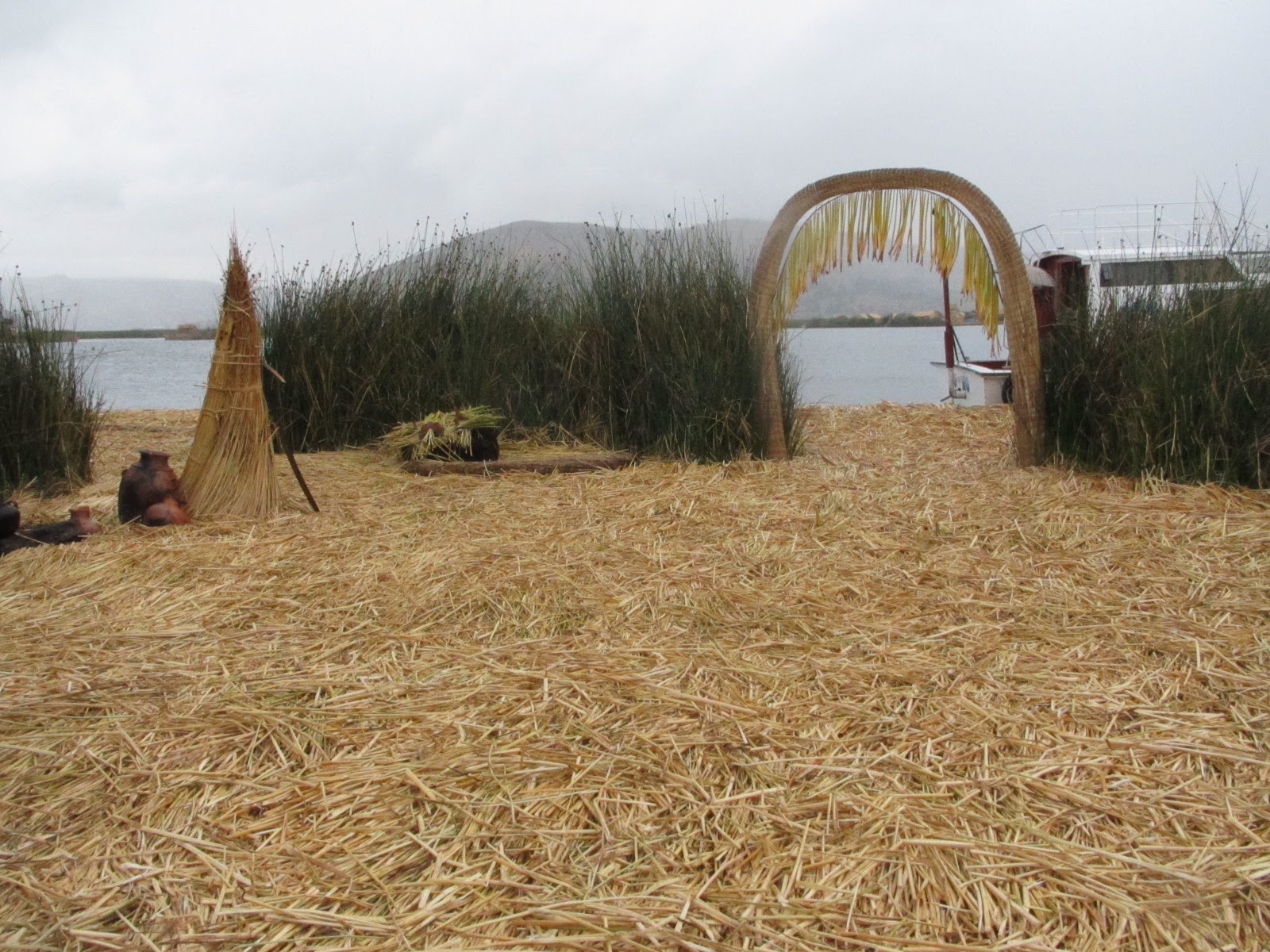
Each island village had an archway entrance.

A cookstove, on a base of nonflammable totora roots.  Fire gets lit in the little space under those pots on top.
Looking across to another nearby island.
They still construct these reed boats (also with an element of plastic bottle core), but they're used only for tourists.  They use little motor boats to get around.
In back of a house.
Tomorrow, the islands of Amantani (including our stay with a family there) and the island of Taquile.