Pages

Friday, April 5, 2013

Portugal for the Young


Portugal dos Pequenitos (Portugal for Children) was built in Coimbra in 1940 to make Portuguese architecture and culture more accessible to children.  It "recreates in small scale and impressive detail traditional Portuguese architecture and history"  It's not been kept up terrifically, but it's still impressive, adorable and appealing.  I would have loved it as a kid or as a destination for my kids.  I was there on a very rainy day; the kids there were oblivious to the rain, reveling in the place. And it was huge.  A few highlights:


For scale.  It's hard to remember, though, since the buildings are all so perfectly replicated; details weren't compromised.

The Pena Palace in Sintra (more in a laer entry).  
Doll furniture of the times.


Replica of a palace in Lisbon.
Replica of a Portuguese town from the 1700s.  All operable, enterable, nothing cordoned off. 

Each has doors that open, with easy entry if you're under 4 feet.  Possible if over.  
Hard to see, but his had a little trellis on the right., with a little vine.   Little
More of the village.  It was huge and included a castle, a blacksmith, city hall, the butcher, the farmers, etc. 
In the little 1700s village there were animal pens, and kids could climb into the little pens and be the pig, cow, or goat.   And they did.  Felt a little creepy to be taking photos of other people's kids doing cute things.  
It even had a miniaturized formal garden, here with a little statue of favorite Queen Isabelle, who loved the poor and almost was done in by her husband for this love -- but the loaves of bread she was carrying under her cloak for the poor  miraculously turned into a bunch of roses, and she was saved..  


And a little church.
With little cloisters.  I'm stooping.


It carried the kid-appeal into the maritime and costume museums, too, so there were toy boats done in nice detail ,but nothing like the over-the-top models used by actual ship builders that we saw in the Maritime Museum. And Barbie/Ken dolls dressed int costumes of "the times".  Some were well done, some were just weird.

One of the weird ones, dressed ca. 1790s.

She "suggested" her children take part, and armed her children for the revolution in 1640, seen here "suggesting".

The favorite Queen Isabelle , with her bread/roses (above.), and a student at Coimbra University -- they dress in black.  

Weird:  "Early man" - wish this photo were better -- he's a ken doll with fuzz and a leaf glued on.  

One of the lovely, well-done ones.  

Bringing into focus Henry the Navigator (L), the one who brought Portugal to prominence in the 1500s , and Vasco Da Gama (R).

I loved this place, for its efforts and successes in making Portuguese history accessible to kids -- and to their adults.  The park also included much more -- the Portuguese colonies and their cultures -- Goa, Mozambique, lots of Brazilian cultures, too, and reflected connections with other countries.  


Thursday, March 28, 2013

Portuguese bits

On our Lisbon hotel balcony  -- note the exterior wall tiles so typical of Lisbon, of Portugal generally.
When this post was started, we were in Coimbra (university town in northern Portugal), just back from dinner at a tasca, a local no name sort of trattoria.  Delicious.  We had local cheese and bread, goat stewed in wine with cabbage, potatoes, garlic, onion and carrots; black pork (a proud local breed) with cabbage and punched potatoes (baked young potatoes that have been punched/smashed then doused in olive oil), and a dessert (sweet cracker layers with cream and cinnamon) and tinto (red) vinho de casa (house wine).  Meals here are often finished with their local favorite port, gratis.  Yum.  So much food, couldn't finish it, and we were there for a couple of hours.  Accompanied by local music (taped) and waitstaff that knew no English.  None.  Interesting, lovely evening, ending with hugs.  What a delight.

We took a train from Sintra to Lisbon to Coimbra, 4 hours of transport, all on trains that ran like clockwork -- organized, on time, comfortable, easy to maneuver, even for non-speakers.  I'd love to be able to provide that for tourists in the US.

An oddness about Portugal:  it's the only country I've ever visited that doesn't have "real" names for the days of the week.  In Portuguese they are Sabado (Saturday in most of the Latin speaking world), Domingo (Sunday, ditto) and then segunda-feira (Monday, translated as the second day), terca-fiera (third-day), quarta-fiera (fourth day) on to sexta-fiera (sixth day).  Logical, but sooo different.

There are so many other anomalies with the language -- in pronunciation, in spelling -- that we've pretty much given up on learning it.  One Portuguese person with whom we spoke mentioned that the Portuguese language is designed to highlight differences between it and Spanish -- letters have been dropped, pronunciation dramatically changed, meanings occasionally altered, to mark the difference.  Mostly.  Hard to believe, but there has to be some reason.  One Portuguese person, when we asked, said to us, "thank us with obrigada/o [standard Portuguese] or merci or danke -- anything but gracias.  We are not Spanish."  A matter of national pride, differentiation.

A few photos of odd Portuguese stuff --  bad, bad internet connection these days.
This is a ladies' bathroom in a national museum.  Bidets are common in women's, not so much in men's rooms.
Gotta keep those lady parts clean.  


A collection of Portuguese neti pots from the 1800s (above), and a mortar and pestle from the 1800s, both from the Pharmacy Museum in Lisbon .
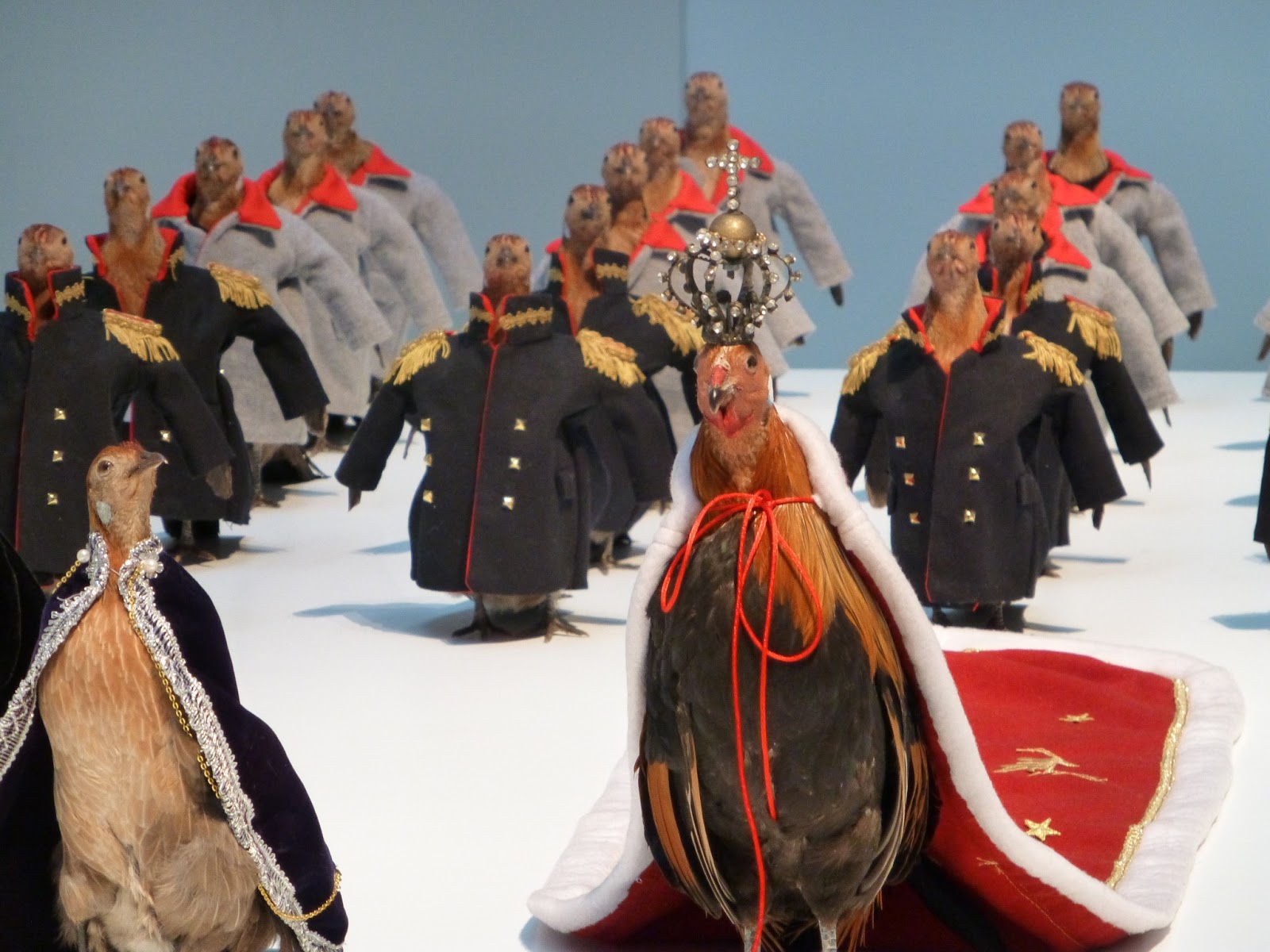
Modern art from Mozambique -- dressed, pompous guinea hens -- displayed  in a Modern Art Museum  in Belem.

Steve, the noble knight, at the national tile museum.
Giant four-leaf clover I found outside the walls of Evora.  My first for 2013.  

Black storks are common in central Portugal.  Here are five nests on electrical towers.  Bad photo, taken from a train.
Mail carrier's bag, Lisbon.  

Insignia of Lisbon's trash servicers.  

A Lisbon fire hydrant.  
Last night while having dinner in another neighborhood tasca, we realized that folks were standing around the TV, transfixed.  The prime minister was resigning due to a lack of confidence vote, economy based.  Not an easy economy to be in.  Shell-shocked folks abound.  A 30-something man with whom we spoke today (our guide through the old city here in Braga) mentioned that so many of his friends are having to leave the country to find work -- his circle of friends is breaking up just to have a working life, a relatively new phenomenon in this society.

Thursday, March 21, 2013

Portugal and a military show of force

We've been in Portugal now for about 10 days, and can't seem to locate the blog habit.  It takes time to make something happen, and we've been so engaged with getting to know Lisbon that it seems to be all we can manage.

With Lisbon looming large and indigestible, but wanting to prime the blog pump, a small presentable chunk emerged on Sunday morning:  we stumbled onto a military parade outside of the Portuguese President Anibal Silva's residence in Belem, just outside of Lisbon.  We were there to see a couple of museums, and were thrilled to hear drums and see shiny helmets in the distance.  Apparently it's a regular Sunday morning occurrence, and included about 250 soldiers (5 women), lots of swords, scabbards, helmets and brass, 4 dogs, about 100 horses and two bands, one on foot, one on horseback.  And about 45 minutes of excitement, equine beauty, music, and pageantry.  Observations:

Mounted brass band, on mostly white horses led the procession, with a marching band behind.  The music was  marchable, but not something either of us knew. 
Marching band in dark uniforms followed the white horse band.  
The main drummer's horse's ears were usually twisting around, but he was really well behaved.  Couldn't be easy with that constant noise.  
And his mane, as well as all the mounted bands' horses manes were braided.  


The 5 ladies on horseback wore ties.  Why?!
Four dogs, three shepherd mixes and a rottweiler.
Sweet, sweet uniforms.  Posture and uniformity of size and seriousness were pretty cool, too.
This leader guy had attitude, and chose to wear his chin strap mid-chin.  Some chose below chin.  Marching band members were exempt from chin straps; mounted ones had them.  Don't know. 
The ones on white mounts had helmet tassles that matched their mounts' tails.  
The "lead" horses were marked with anklets -- dark ones with blue, white ones with red.

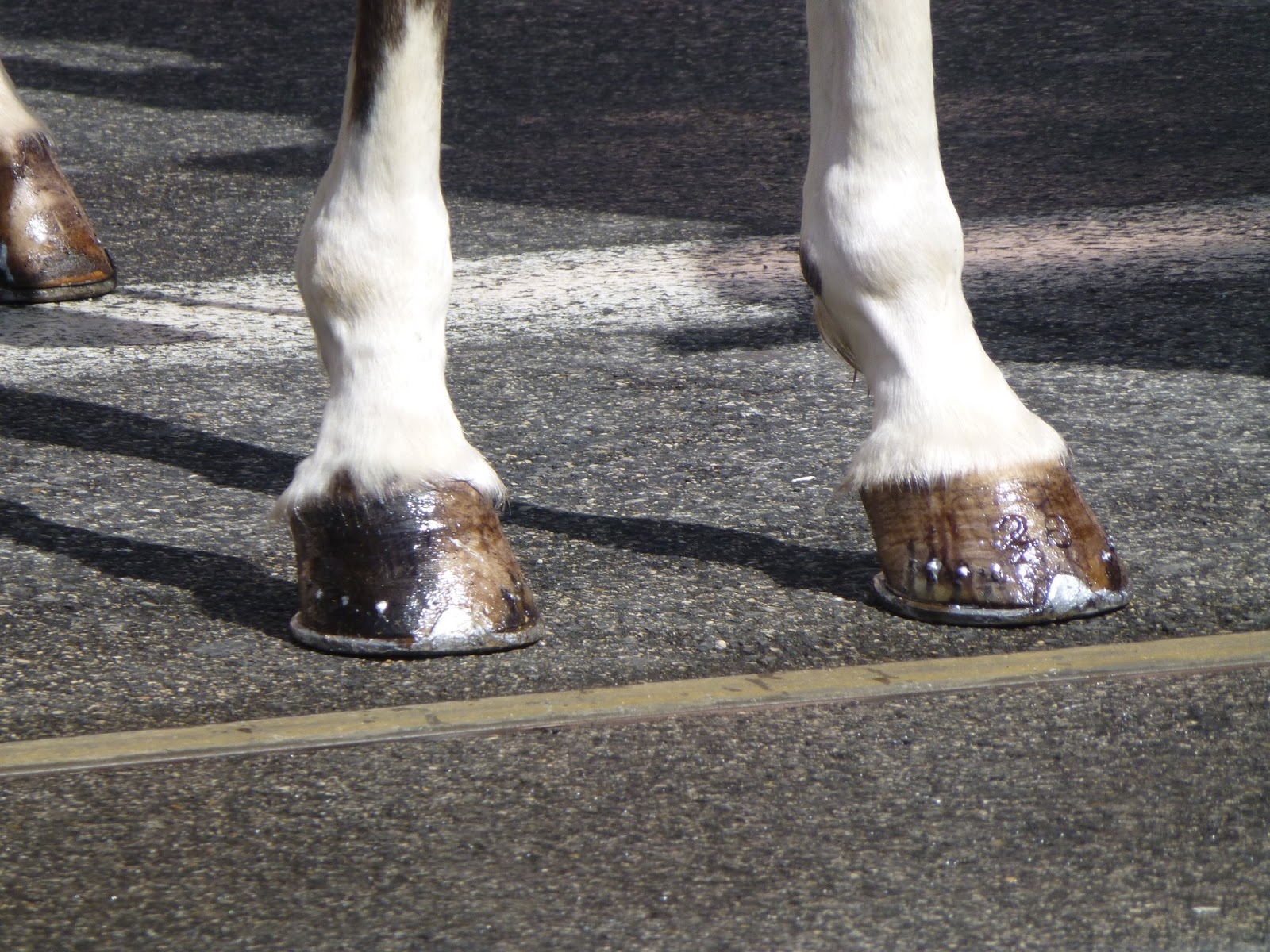
And the horses all had had pedicures -- sporting shiny hooves for the procession.  
The horses also had special rump combing for the day -- quite lovely.  Less visible on the whites' rears, but it was there (see three photos up).

Swords raised, on command.  Steve had an Onion-like thought including the headline  "Massacre on Belem street,  officer apologizes for garbled command."
Back to their Sundays.

The street cleaner, ready to pick up the inevitable horse leavings.

Portuguese is not an easy language.  When written it is much like Spanish, and is borderline accessible then, but when spoken, it becomes an undecipherable Russian-like melodic mess -- easy to enjoy, impossible to understand (from here).  As in most parts of the world, making the attempt is appreciated, and then their frequently-accessible layer of English emerges.  Sigh.  To be born into the current lingua-franca has many blessings.

We really don't know if anyone's interested in this blog.  If you are and have thoughts as to what might be fun to read about, please let us know by comment on this page or by email to either of us.

Saturday, February 9, 2013

Skulls, a last look at a bird paradise, an oasis, and accountancy

Ah, Peru.  It was pretty delightful.  Our last days in South America were spent in and around the town of Paracas, on the Pacific coast of Peru.  This is our last South American entry finally.  Sigh . . . done with South America. 


On our last morning in Peru, I went on a second boat trip to the Ballestas Islands for one final glimpse of the amazing wildlife.
Famous "candelabra" carved into the mountain ca. 500AD on a nearby island.  Similar to the famous Nazca lines.
Sea lions drape themselves over the rocks, each other -- they look so soft, snuggly and comfortable.  
Turkey vultures are plentiful on the Ballestas -- waiting, hoping for a dead sea lion baby, fetus, mom or placenta.  These are perched on part of the structure in place for the lucrative every 7-year harvesting of the guano produced by the guano cormorant, below. 
Endangered red-legged cormorant.
The dark, seeming-shadow on the left side of the island is thousands of guano cormorants warming in the sun.
  Sweet healthy multitudes.

There's an oasis nestled among the sand dunes in the Peruvian northern extension of the Atacama desert.  The oasis is about 30 miles north of Paracas.  I'd never seen one before.  Not visible in the photos:  dunebuggies crawling like ants over the dunes.  


This gull dined on a dead skate -- not easy eating, as they're pretty rubbery when freshly dead.  Gotta shake it around to get little bits off.

This egret was in breeding plumage - these lovely feathers, preferred hat decorations, almost led to their extinction.

Our last afternoon was spent in a little local skull museum in Paracas -- the only skull museum I've ever seen.  It's a one room museum, with a very old, very knowledgeable director/guide who gave us a personal tour of artifacts, mostly skulls displaying intentional cranial deformations.  The Paracas nobility practiced this from about 700 BCE with several different types of uh modification, always done on infants, as the skull and patient are more pliable and compliant then.  They also practiced trepanation (skull cutting, basically) to treat health problems, and remedy head trauma from battle.  These practices didn't always enhance survival odds - of babies or other patients.  
Trepanation performed on a "modified" skull owner.
Elongated, obviously.


A broadened, flattened skull.


Head binding pad, with a picture of how it'd be applied.  Usually stayed in place for at least 6 months, sometimes longer, if the patient was compliant and not dead.
And finally - accounting.  This is the quipu, a knotted alpaca yarn tool used by the Incas for accounting.

This one shows the record keeping in process.                                                                                                                              
And an Inca accountant with a fresh ledger.
Steve, amused by the books.

That we've been "on the road" for 9 months comes as a surprise -- seems like lots of water under the bridge, also seems like it was just a short time ago we were dreaming all this up.  Maybe its because we're so old?  I don't know, but we're enjoying Portland, loosely planning our next adventure which will include Portugal and southern Spain in March/April, then over to the British Isles for the summer.  Rather amazing year, and while there's a wedding in September (Gen's!) that'll bring us back, we're not sure whether we'll be ready to settle down then, or take off in another direction.  It's almost easier in some ways to keep going, rather than face the storage area and have to make a decision about the next chapter.  Yet I think we both long for  normalcy.  And we miss you all in that normalcy!  Two sides to every coin.